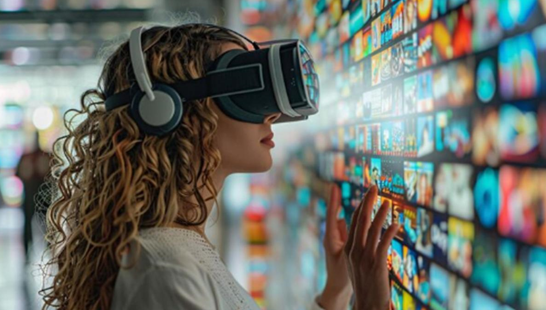
Virtual reality has moved far beyond its early reputation as a niche technology for gamers and technology enthusiasts. Today, VR is becoming an increasingly important part of digital entertainment, offering experiences that feel more interactive, personal, and immersive than traditional screens. From gaming and virtual travel to live events, social platforms, and specialized video content, virtual reality is changing the way people interact with digital media.
The appeal of VR comes largely from its ability to create a sense of presence. Instead of simply watching something on a television, computer, or smartphone, users can enter a digitally created environment and look around as though they are physically present. Head tracking, spatial audio, motion controllers, and increasingly sophisticated displays all contribute to this effect.
As VR hardware becomes more accessible, content creators are also exploring new ways to use the technology. This includes entertainment designed specifically for immersive viewing, where users can experience digital environments from different perspectives rather than remaining passive viewers.
Understanding the Growth of Virtual Reality
Virtual reality creates a computer-generated environment that can respond to a user’s movements and interactions. A typical VR headset combines display technology, motion tracking, lenses, and sensors to produce an immersive visual experience.
Modern headsets have improved considerably compared with earlier generations. Higher-resolution displays can provide sharper images, while improved tracking makes movement feel more natural. Wireless designs have also reduced the dependence on powerful computers and cables.
These improvements have helped VR reach a broader audience. Users no longer need to be technology experts to enjoy many VR experiences. Standalone headsets can provide access to games, applications, videos, social environments, and other forms of entertainment with relatively little setup.
The growth of VR is also being supported by the development of better content. Hardware alone cannot create a compelling experience. Developers and creators need to produce material that takes advantage of the unique characteristics of immersive media.
See also: How to Choose Sustainable Thesis Printing and Graduation Gifts
Why Immersive Entertainment Feels Different
Traditional digital entertainment usually places the viewer outside the experience. A movie, television program, or standard online video appears on a fixed screen, while the viewer observes the action from a predetermined perspective.
VR changes this relationship.
A user can often look in different directions, interact with virtual objects, or move through an environment. This additional freedom can make entertainment feel more engaging because the viewer is not simply watching a sequence of images.
Spatial audio is another important component. Instead of receiving identical audio through both sides of a headset, VR systems can simulate sounds coming from specific directions. A sound behind the user, for example, can appear to originate from behind them. When combined with visual tracking, this can make a virtual environment feel significantly more convincing.
This principle applies to many categories of entertainment. Games can become interactive worlds, concerts can offer virtual front-row perspectives, and video experiences can provide a greater sense of physical presence.
VR Video and Immersive Streaming
Video is one of the most interesting areas of VR development. Conventional streaming services generally deliver flat video, but immersive video can provide a much broader field of view and, depending on the format, allow viewers to look around a recorded environment.
360-degree video is a well-known example. Cameras capture imagery in multiple directions, allowing viewers wearing a compatible headset to explore the scene by moving their heads.
Other forms of immersive video go further by incorporating depth, interactive elements, or specialized camera techniques. These formats can be particularly effective when the subject benefits from a strong sense of location.
Entertainment platforms are increasingly experimenting with different approaches to immersive video. Some focus on gaming-related content, while others explore travel, sports, education, performances, and specialized entertainment.
For users interested in a broader range of VR video experiences, VSpy represents one example of a platform operating within the immersive entertainment space. The wider development of these platforms illustrates how VR is creating new categories of digital media rather than simply replacing existing ones.
The Importance of VR Headsets
The headset remains the central piece of hardware in most VR experiences. Its display, lenses, comfort, tracking capabilities, and processing power can all influence how enjoyable an experience becomes.
Resolution is particularly important because the screen sits close to the user’s eyes. A higher-resolution display can reduce visible pixelation and make text and detailed environments easier to see.
Field of view is another consideration. A wider field of view can make an environment feel more natural because more of the user’s peripheral vision is occupied by the virtual scene.
Comfort is equally important. A headset that feels heavy or poorly balanced can become uncomfortable during longer sessions. Manufacturers therefore continue to experiment with lighter materials, improved straps, better weight distribution, and more efficient components.
Wireless connectivity has also become an important feature. Removing cables can provide greater freedom of movement and reduce physical distractions. However, wireless systems still depend on factors such as battery capacity, network performance, and hardware processing capabilities.
The Role of Mixed Reality
VR is not the only immersive technology gaining attention. Mixed reality combines digital elements with the physical environment, creating experiences in which virtual objects can appear to interact with the real world.
This approach is sometimes associated with augmented reality, although the technologies can differ in how extensively digital and physical environments are combined.
Mixed reality has applications beyond entertainment. It can support training, product visualization, education, design, remote collaboration, and other activities.
For consumers, however, entertainment remains an important driver. Imagine playing a game in which virtual characters appear to occupy the physical space around you, or watching digital content while still being aware of your surroundings.
As hardware becomes more capable, the boundaries between VR, AR, and mixed reality are becoming increasingly fluid.
Privacy Considerations in Immersive Technology
The immersive nature of VR also creates important privacy considerations.
Traditional websites can collect information such as browsing behavior, account details, and device information. VR systems can potentially introduce additional categories of data because they interact with physical movement and user behavior.
Depending on the device and application, information may include head movement, hand movement, room dimensions, interaction patterns, and other technical data.
This does not mean that every VR application collects all of this information. Data practices vary significantly between manufacturers, applications, and services. Users should therefore review privacy policies and available settings before using a new platform.
Account security is also important. Strong passwords, appropriate privacy settings, software updates, and careful management of connected accounts can help reduce unnecessary exposure.
People using VR for private forms of entertainment should pay particular attention to account security and device privacy. Shared devices should be handled carefully, and users should understand what information applications request before granting permissions.
Creating Better VR Experiences
Good VR content requires more than simply placing conventional media inside a headset. Creators need to consider how viewers move, where they look, and how they respond to changes in their surroundings.
Fast camera movements, excessive visual effects, or poorly designed environments can make some users uncomfortable. Developers therefore need to consider motion, frame rate, perspective, and interaction carefully.
Comfort should be treated as part of the design rather than an afterthought.
High-quality VR content also benefits from clear spatial organization. Users should understand where important objects or events are located without being overwhelmed by unnecessary information.
Sound design can make a major difference as well. Directional audio can guide attention and create a stronger sense of presence without requiring constant visual cues.
These principles apply across gaming, video, virtual events, educational applications, and other immersive experiences.
The Changing Digital Entertainment Landscape
One of the most significant effects of VR is the expansion of what digital entertainment can mean.
For decades, entertainment largely followed a screen-based model. Movies appeared on televisions and cinemas, games appeared on monitors and consoles, and online videos appeared on computers and mobile devices.
VR introduces another possibility: entertainment as an environment.
Instead of simply viewing a story, users may be able to explore a setting. Instead of watching a performance from one camera angle, they may be able to choose where they look. Instead of interacting with a game through a controller while looking at a screen, they can physically participate within a virtual space.
This shift does not mean traditional entertainment will disappear. Flat-screen media remains convenient, inexpensive, and widely accessible. Instead, VR is becoming another option within an increasingly diverse digital entertainment ecosystem.
Accessibility and the Future of VR
Accessibility will be an important factor in the continued development of VR. Hardware companies and software developers are increasingly considering how different users interact with immersive systems.
Adjustable text sizes, customizable controls, seated experiences, subtitles, audio options, and alternative interaction methods can make applications more usable for a wider range of people.
Affordability is another consideration. As technology develops, older hardware can become less expensive, potentially allowing more consumers to experience VR without purchasing premium equipment.
Content availability will also influence adoption. A headset is more valuable when users have a wide selection of high-quality applications and entertainment options.
The industry therefore faces a balance between improving technology and creating enough compelling content to justify continued consumer interest.
What Comes Next for Immersive Entertainment?
The future of VR entertainment is likely to involve greater integration between hardware, software, artificial intelligence, spatial computing, and online services.
Headsets may become lighter and more comfortable, while displays and tracking systems continue to improve. Advances in wireless connectivity could make immersive streaming more practical, while better compression technologies may help deliver high-quality video without requiring extremely powerful local hardware.
Artificial intelligence could also influence content creation. AI-assisted development may help creators generate environments, characters, dialogue, and interactive elements more efficiently. At the same time, human creativity and careful design will remain important because compelling entertainment depends on more than technical generation.
Another possibility is greater interoperability between platforms. As immersive technology becomes more common, users may expect their digital identities, purchases, social connections, and entertainment experiences to work across multiple devices and services.
Final Thoughts
Virtual reality is becoming an important part of the broader digital entertainment industry. Its defining advantage is not simply better image quality but the ability to create a stronger sense of presence and participation.
From VR video and interactive games to mixed reality applications and specialized entertainment, the technology is opening new possibilities for creators and audiences. Improvements in displays, tracking, wireless hardware, spatial audio, and content production are helping make these experiences increasingly practical.
At the same time, responsible use remains important. Privacy, account security, comfort, accessibility, and responsible content design should all be considered as immersive technology continues to develop.
The future of digital entertainment is unlikely to be limited to one format. Traditional screens, mobile devices, gaming systems, VR headsets, and mixed-reality hardware can all coexist. VR’s contribution is the introduction of a more immersive way to experience digital content—one that places the user closer to the center of the experience rather than simply in front of a screen.
