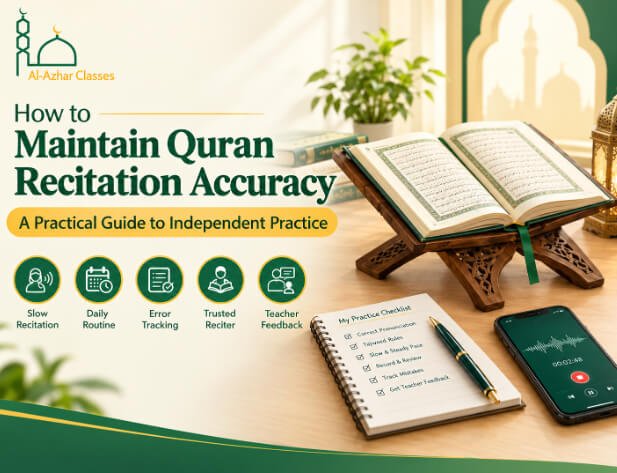
Reciting alone feels peaceful, yet it is also where small errors settle in unnoticed. A letter pronounced slightly wrong fifty times becomes a habit that takes far longer to undo than it would have taken to prevent. Students who want to improve Quran recitation with Tajweed on their own between lessons need a simple system, and this guide lays one out.
Why Accuracy Slips When You Practice Alone
Without a teacher in the room, nobody stops you at the moment of the mistake. Your ear also adapts to your own voice, so an error you repeat begins to sound correct. Fatigue adds to the problem, since attention drops in the last minutes of a long session and rushed endings are where most slips happen.
None of this means independent practice is a poor choice. It means the practice needs structure. The Quran itself sets the standard in the instruction to recite in measured tones (Surah Al-Muzzammil, 73:4), and the Prophet (peace be upon him) described the skilled reciter as one who will be with the noble angels. Careful, unhurried recitation is the goal from the first day.
Start With a Solid Foundation
Accuracy begins with the sounds themselves. Scholars commonly describe 17 points of articulation, called makharij, and each letter also carries qualities such as heaviness, lightness, and echo. If these are weak, no amount of repetition will fix the recitation.
Before building a daily routine, check three basics:
- Can you say each Arabic letter from its correct point of articulation?
- Can you separate close pairs, such as the heavy and light letters?
- Can you hold elongations for their correct length?
If any answer is no, revisit the basics with a teacher first. A guide on how to perfect your recitation is a useful companion for this stage.
Build a Short, Fixed Daily Routine
Short sessions held at the same time each day work better than occasional long ones, because accuracy depends on attention. Twenty to thirty focused minutes is a realistic target for most students. Many people find a routine easier to keep when they plan how to learn Quran online from your home, with a quiet corner and a set time.
A simple session can follow this order:
- Begin with a short dua and a few minutes of listening to the passage.
- Review yesterday’s lines before adding anything new.
- Recite today’s portion slowly, one verse at a time.
- End with one clean, complete reading of the portion.
Beginners often do well with short surahs, since the ending of a short surah gives a clear checkpoint. If that suits you,Juz Amma memorisation offers a sensible place to start.
Record Yourself and Listen Back
A phone recorder is the closest thing to a second pair of ears. Recordings let you hear your recitation as a listener would, and the difference can be surprising.
Try this method:
- Record the same passage once a week.
- Play it beside a trusted reciter, line by line.
- Note every place where a letter, elongation, or stop differs.
- Practice only those places the next day.
Keep the recordings. After a month, listening to the first one shows progress that is easy to miss day to day.
Slow Down and Recite With Measure
Speed hides mistakes. At a slow pace, each rule has time to appear, and your mouth has time to form each letter correctly. Many teachers advise building accuracy first and speed later, since speed comes naturally once the rules are automatic.
A practical tip is to recite one verse three times: once very slowly, once at a steady pace, and once at your normal pace. If an error appears in the third reading, return to the slow one.
Pay Attention to Stopping and Starting
Many accuracy problems appear at the end of a verse or when a breath runs out. Waqf, the rules for stopping, and ibtida, the rules for resuming, change how the last letter of a word sounds and where a phrase can safely end. Learn the common stopping signs printed in your Mushaf and plan your breath before reciting each verse. If you run out of air mid-phrase, go back to the start of the phrase and recite it again.
Mark Your Mushaf and Keep an Error Log
A written record turns vague worry into a clear task list. Use a Mushaf with color-coded Tajweed, or mark your own copy lightly in pencil. Beside the text, keep a small notebook with three columns: the verse, the mistake, and the fix.
Review the notebook weekly. Patterns appear quickly. Many students find that most of their errors come from only two or three rules, and that is a far smaller job than trying to fix everything at once.
Listen to Trusted Reciters
Listening trains the ear before the mouth. Choose one reciter with a clear, steady pace and a recitation style that matches your teacher’s, then follow along in the Mushaf. Repeat each verse after the reciter, matching length, pause, and tone.
One caution applies. Switching between many reciters can blur your standard, because each may use a different recitation tradition or pace. Pick one main reference and stay with it for a season.
Schedule Regular Teacher Checks
Independent practice works best as a supplement, not a replacement. A teacher hears what recordings and apps miss, such as a slightly thin letter or an elongation that is half a beat short. Regular one-on-one online sessions give you correction at the exact point of the mistake. Qualified guidance from certified Quran teachers also protects you from practicing a wrong habit for months.
A good rhythm is to practice daily and meet your teacher weekly. Bring your error log and your recordings to each lesson, so the lesson time goes to the hardest problems.
Common Challenges in Independent Practice
- Inconsistency: busy weeks break the routine, and accuracy falls with it.
- Overconfidence: familiar passages get recited fast and carelessly.
- Unheard mistakes: without feedback, errors feel correct.
- Too many sources: mixing reciters and rules creates confusion.
- Motivation dips: progress feels slow when nobody is checking.
A small fix helps with most of these. Set a minimum session, such as ten minutes, for the days when time is short, so that the habit stays alive.
Trends Shaping Independent Practice
More students now combine self-study with live teaching. Video lessons such as Zoom Quran classes let a learner recite to a teacher from any time zone, and recording tools make weekly review easy. Automated recitation apps are also growing. They can flag obvious errors, but they cannot judge subtle points the way a trained teacher can, so treat them as a helper rather than a judge.
A Weekly Accuracy Checklist
Use this list every weekend:
- Did I practice at least five days this week?
- Did I record and review one passage?
- Did I update my error log?
- Did I fix the top two mistakes from the log?
- Do I have questions to bring to my teacher?
Frequently Asked Questions (FAQs)
1. How can I check my Quran recitation accuracy without a teacher?
Record the same passage once a week and play it beside a trusted reciter, line by line. Note every difference in letters, elongations, and stops, then practice only those places. Recordings catch many errors, but a teacher hears what they miss, so pair them with interactive online Quran learning courses that give live feedback.
2. How often should I meet a teacher during independent practice?
Once a week suits most students. Daily practice builds the habit, and a weekly check corrects it before mistakes settle in. A specialized online Quran school can arrange a regular slot and review your recordings each time.
3. How long should I practice each day to keep my Tajweed accurate?
Twenty to thirty focused minutes is a realistic target. A fixed time matters more than a long session. On very busy days, keep a ten-minute minimum so the habit survives, and consider convenient Quran courses online if your schedule changes often.
4. Can children practice Tajweed on their own?
Children do best with short sessions and an adult or teacher nearby to listen. Independent practice is useful only after a teacher has corrected the basics. Parents can read about the benefits of Tajweed classes for kids to see how supervised lessons support daily practice.
5. Are low-cost lessons enough to maintain good recitation?
They can be, if the teacher is qualified and gives personal correction. Cost matters less than how closely someone listens to your recitation. Families comparing prices can look at affordable Tajweed classes online and check the teacher’s credentials first.
6. Can recitation apps replace a teacher?
Apps can flag obvious errors and are handy for daily review. They struggle with subtle points, such as a slightly thin letter or a short elongation. Use them as a helper between lessons, and choose among the best online Quran classes for the final judgment on your Tajweed.
See also: Professional Radio Communication Technology for Mexican Businesses
Conclusion
Accuracy during independent practice comes from small, repeatable habits: strong basics, a fixed routine, slow recitation, recordings, an error log, one trusted reciter, and regular teacher checks. Each habit is simple on its own, and together they protect your recitation between lessons. Al Azhar Classes offers live online guidance with experienced teachers, so your daily practice always has a qualified listener behind it. Start with one habit this week and add the next when it feels natural.
